Belly fat is one of the most common reasons people start exercising.
You may have noticed that your clothes are becoming tighter around the waist, your stomach looks different in the mirror, or your body weight is increasing even though you feel like you are exercising regularly.
The natural question is:
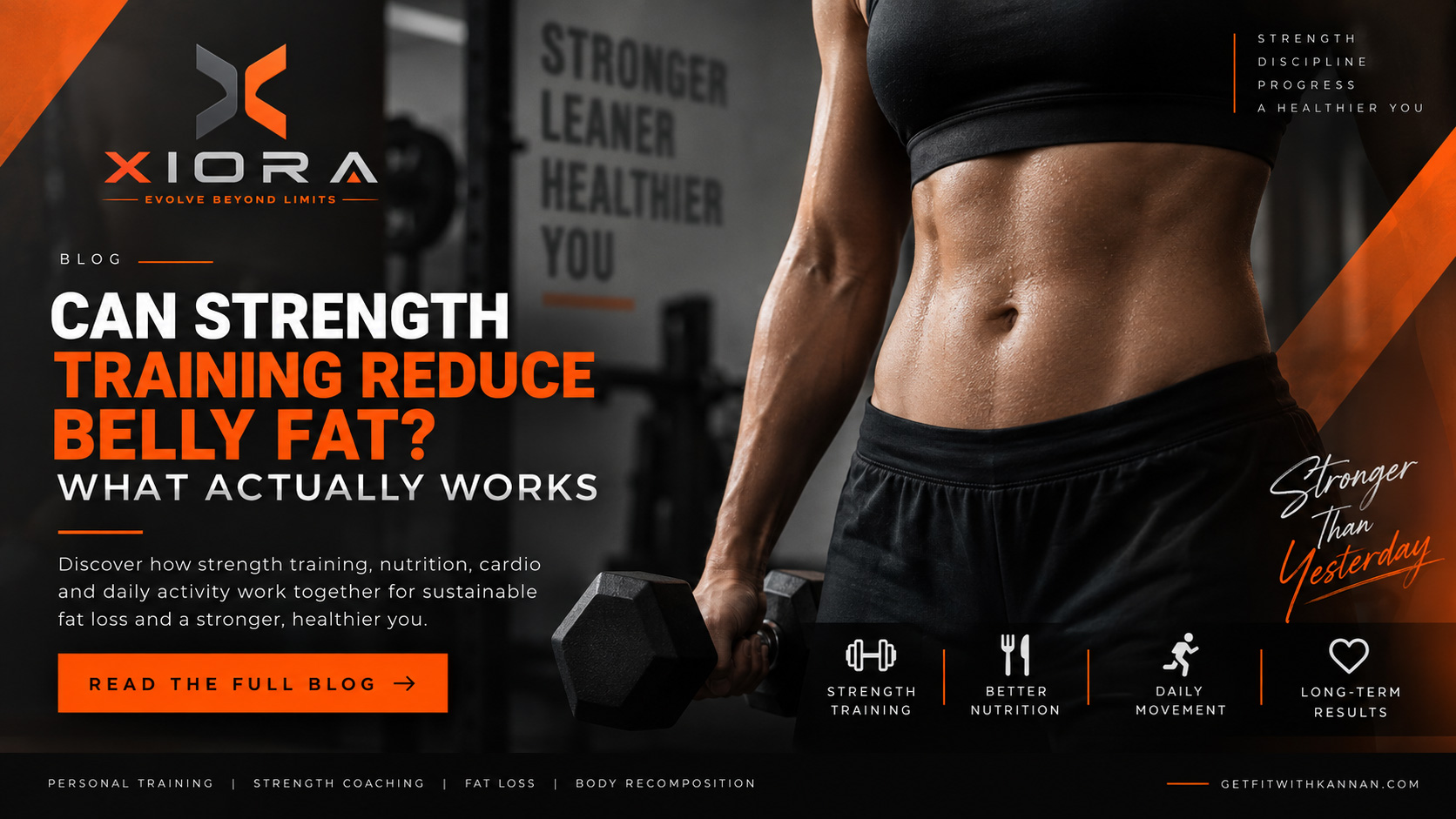
Can strength training reduce belly fat?
The answer is yes, strength training can play an important role in reducing overall body fat and improving your body composition — but you cannot specifically choose where your body loses fat first.
Reducing belly fat is not about doing hundreds of crunches or spending hours on a treadmill. It is about creating a sustainable combination of strength training, nutrition, daily movement, cardiovascular activity and recovery.
For someone trying to lose fat while maintaining or building muscle, strength training can be a particularly valuable part of that process.
✅ Quick Answer: Can Strength Training Reduce Belly Fat?
The Short Answer
Yes. Strength training can support the reduction of belly fat by helping you maintain or build muscle while reducing overall body fat. However, strength training cannot specifically target belly fat for removal.
Your body determines where it stores and loses fat based on factors including genetics, hormones, age and overall energy balance.
That means the goal should not be to find a magical exercise that burns stomach fat.
The goal is to improve overall body composition.
What Strength Training Can Actually Do
A well-designed strength programme can help you:
- Build and preserve muscle
- Improve strength and physical capacity
- Increase training-related energy expenditure
- Support fat loss
- Improve body composition
- Maintain muscle while dieting
- Build a stronger and more functional body
This is why strength training is often more useful than simply chasing the number of calories burned during one workout.
✅ What Is Belly Fat?
Not all abdominal fat is exactly the same.
Broadly, body fat around the abdomen can include subcutaneous fat, which sits underneath the skin, and visceral fat, which is stored deeper around internal organs.
Visceral fat is particularly important from a health perspective, which is one reason reducing excess abdominal fat should be viewed as more than simply an aesthetic goal.
✍️ Subcutaneous Fat
Subcutaneous fat is the fat that sits directly beneath your skin.
It is the type of abdominal fat you can generally pinch with your fingers.
✍️ Visceral Fat
Visceral fat is stored deeper inside the abdominal cavity.
You cannot directly see or measure it simply by looking at your stomach, which is why overall health, waist measurements, body composition and lifestyle habits matter more than appearance alone.
✅ Can You Target Belly Fat With Exercise?
✍️ Why Spot Reduction Doesn’t Work
One of the biggest misconceptions in fitness is that exercising a particular body part will force your body to burn fat from that exact location.
For example:
- Crunches will burn belly fat.
- Leg raises will remove lower-belly fat.
- Side bends will remove love handles.
Unfortunately, the body does not work that way.
Doing abdominal exercises can strengthen your abdominal muscles, but it does not guarantee that the fat covering those muscles will disappear.
✍️ What Happens When Overall Body Fat Decreases?
When you consistently expend more energy than you consume, your body can draw on stored energy.
As overall body fat decreases, abdominal fat may decrease as part of that process.
However, the rate and order of fat loss differ from person to person.
This is why comparing your progress with someone else’s can be misleading.
✅ Why Strength Training Matters for Fat Loss
Strength training is not simply about getting stronger or building large muscles.
It can also be an important tool when your goal is to improve body composition.
✍️ Strength Training Helps Preserve Muscle
When people lose weight, the goal is usually not simply to make the number on the weighing scale smaller.
Ideally, you want to reduce excess fat while maintaining as much lean muscle as possible.
Resistance training provides your body with a reason to maintain muscle while you work towards fat loss.
This becomes particularly important when you are eating in a calorie deficit.
✍️ Building Muscle Can Improve Body Composition
Two people can weigh exactly the same but have very different amounts of muscle and body fat.
This is why body composition can be more useful than body weight alone when evaluating long-term progress.
You may sometimes see changes in:
- Waist circumference
- Clothing fit
- Muscle definition
- Strength
- Body measurements
- Overall physique
even when the weighing scale is not changing dramatically.
✍️ Progressive Overload Matters
Simply repeating the same workout forever is unlikely to produce continuous improvement.
A structured strength programme gradually challenges the body through appropriate increases in:
- Resistance
- Repetitions
- Sets
- Exercise difficulty
- Training quality
This principle is known as progressive overload.
✅ Does Lifting Weights Burn Fat?
✍️ Calories Burned During Training
Yes, strength training uses energy.
However, focusing only on how many calories a workout burns misses the bigger picture.
A good strength-training programme is designed to create adaptations that improve your physical capacity and help you maintain muscle while pursuing fat loss.
✍️ The Bigger Picture of Energy Expenditure
Your daily energy expenditure comes from more than exercise.
It includes things such as:
- Basal metabolic functions
- Daily movement
- Exercise
- Digestion
- Other physical activity
Therefore, a fat-loss strategy should consider your entire day, not just the 60 minutes you spend inside the gym.
✍️ Why Strength Training Shouldn’t Be Judged Only by Calories Burned
A workout can be valuable even if it does not display an impressive calorie number on a fitness tracker.
The purpose of strength training is not simply to burn as many calories as possible.
It is to help you become stronger, fitter and better conditioned while supporting a healthier body composition.
✅ Cardio vs Strength Training for Belly Fat: Which Is Better?
There is no need to treat strength training and cardio as competing approaches.
They can complement each other.
✍️ What Cardio Does Well
Walking, running, cycling, swimming and other aerobic activities can contribute to energy expenditure and cardiovascular fitness.
Cardio can therefore be a useful part of a fat-loss programme.
✍️ What Strength Training Does Well
Strength training focuses on improving muscular strength and preserving or building lean tissue.
This makes it especially valuable when the goal is not simply to lose weight but to change body composition.
✍️ Why Combining Both Can Be More Effective
For many people, a practical programme may include:
Strength training + daily movement + appropriate cardio + nutrition
rather than relying entirely on one form of exercise.
The exact combination should depend on your goals, fitness level, schedule and recovery capacity.
✅ How Often Should You Strength Train for Fat Loss?
There is no single number that works for everyone.
Training frequency should depend on your current experience, goals, recovery and lifestyle.
✍️ A Practical Weekly Training Structure
For many people, a structured programme can involve strength training several times per week while allowing enough recovery between sessions.
The important part is not simply going to the gym every day.
It is having a programme that allows you to:
- Train consistently
- Progress gradually
- Recover properly
- Maintain good technique
- Manage your overall workload
✍️ Why Consistency Matters More Than a Perfect Programme
The best programme is often the one you can actually follow consistently.
A theoretically perfect workout plan is of little value if your work schedule, lifestyle or recovery makes it impossible to maintain.
✅ What Does a Fat-Loss Strength Training Programme Look Like?
A well-rounded programme does not need to be complicated.
✍️ Full-Body Strength Training
Training major movement patterns can help develop a balanced and functional body.
Depending on the individual, exercises may involve movements such as:
- Squatting
- Pushing
- Pulling
- Hinging
- Carrying
- Core stability
The exact exercises should be selected according to the individual’s ability and training goals.
✍️ Progressive Overload
Your programme should provide an appropriate training stimulus and progress over time.
That does not necessarily mean adding weight every session.
Progress can also mean improving technique, repetitions, control, range of motion or exercise difficulty.
✍️ Conditioning and Cardio
Cardiovascular training can be added according to the individual’s requirements.
It does not need to replace strength training.
✍️ Recovery
Training is only one part of the equation.
Recovery, sleep and managing training stress are also important when pursuing sustainable progress.
✅ Nutrition: The Part You Cannot Ignore
You cannot consistently out-train an unsuitable diet and expect exercise alone to solve the problem.
✍️ Calorie Deficit
For fat loss to occur, energy intake and expenditure need to create an appropriate energy deficit over time.
This does not mean starving yourself.
A sustainable approach is generally more useful than an extreme short-term diet.
✍️ Protein Intake
Adequate protein is important when your goal includes maintaining or building muscle.
Combined with resistance training, sufficient protein can support the preservation of lean mass during fat loss.
✍️ Food Quality and Consistency
Your overall eating pattern matters.
A practical approach can include:
- Adequate protein
- Vegetables and fruits
- High-fibre foods
- Appropriate carbohydrate sources
- Healthy fats
- Adequate hydration
✍️ Why Extreme Diets Usually Aren’t the Answer
Very restrictive diets may produce rapid changes on the weighing scale, but they can be difficult to maintain.
The objective should be to develop eating habits that can continue beyond a short-term challenge.
✅ Don’t Ignore Your Daily Activity
Your workout is only one part of your activity level.
✍️ Walking and Daily Movement
Walking, taking stairs, moving around at work and other everyday activities contribute to your overall energy expenditure.
✍️ Why Steps Can Support Fat Loss
Increasing daily movement can be a practical way of becoming more active without needing to add another intense workout.
For a busy professional, this can be particularly useful.
✍️ The Importance of an Active Lifestyle
You do not need to spend your entire day exercising.
Instead, look for opportunities to move more throughout your normal day.
This is where NEAT — Non-Exercise Activity Thermogenesis — becomes relevant.
✅ Do Ab Workouts Burn Belly Fat?
✍️ What Abdominal Exercises Actually Do
Abdominal exercises can strengthen your core muscles.
Exercises such as planks, crunches, dead bugs and other core movements can have a place in a well-designed training programme.
✍️ Building Stronger Core Muscles
A stronger core can contribute to better control and performance during various movements.
However, stronger abdominal muscles do not automatically mean less abdominal fat.
✍️ Why Hundreds of Crunches Aren’t the Solution
If your objective is to reduce belly fat, doing hundreds of repetitions of one abdominal exercise is not a substitute for an overall fat-loss strategy.
Train your core.
But do not confuse training the abdominal muscles with burning abdominal fat specifically.
✅ What Actually Works for Losing Belly Fat?
If reducing excess abdominal fat is your goal, focus on the fundamentals.
✍️ The Fat-Loss Formula
1. Strength train consistently
Use resistance training to build or preserve muscle.
2. Create an appropriate calorie deficit
Nutrition needs to support your fat-loss goal.
3. Eat enough protein
Prioritise adequate protein as part of a balanced diet.
4. Increase daily movement
Walking and general activity can make a meaningful difference.
5. Add cardio when appropriate
Use aerobic activity to support fitness and energy expenditure.
6. Recover properly
Sleep and recovery should not be treated as optional.
7. Stay consistent
Body-composition changes take time.
There is no single exercise that replaces these fundamentals.
✅ What If Your Waist Size Isn’t Changing?
If you have been training consistently but your waist measurement is not changing, look at the entire system rather than immediately changing your workout.
✍️ You’re Not Actually in a Consistent Calorie Deficit
Small differences between expected and actual food intake can accumulate over time.
Review your overall eating habits rather than assuming that exercise alone is enough.
✍️ Your Activity Outside the Gym Has Decreased
Sometimes people exercise more but unconsciously move less during the rest of the day.
Your overall activity level matters.
✍️ You’re Not Progressing Your Training
If your programme has remained unchanged for months, it may need to be reviewed.
✍️ You’re Expecting Results Too Quickly
Fat loss is not perfectly linear.
Daily body weight can fluctuate because of hydration, food intake and other factors.
Look at longer-term trends rather than individual weigh-ins.
✍️ Other Factors May Affect Progress
Sleep, stress, lifestyle, medications and other individual factors can influence body weight and body composition.
If you have concerns about unexplained changes in weight or health, speak with an appropriate healthcare professional.
✅ Strength Training for Fat Loss in Trivandrum
For people searching for strength training in Trivandrum or a personal trainer in Trivandrum, the important question is not simply which gym has the most equipment.
The bigger question is whether your training programme is appropriate for you.
Your goals, training experience, schedule, limitations and lifestyle should influence how your programme is designed.
✍️ Personalised Strength Coaching in Trivandrum
At Xiora / Get Fit With Kannan, coaching is built around individual goals and training needs.
The approach includes strength training, muscle building, fat loss, body recomposition, mobility and personalised fitness planning.
The objective is not to give everyone the same workout.
It is to create a structured approach that can realistically fit the person’s lifestyle and progress over time.
✍️ Who Can Benefit From Personalised Coaching?
Personalised coaching can be useful for:
- Beginners who need structured guidance
- Working professionals with limited training time
- People looking to build strength
- Individuals pursuing fat loss
- People interested in body recomposition
- Those who want one-to-one personal training
- Individuals looking for structured online strength coaching
✅ AEO Quick Answers
✍️ Can Strength Training Reduce Belly Fat?
Yes. Strength training can support overall fat loss and improve body composition, which can contribute to a reduction in belly fat. However, you cannot specifically choose where your body loses fat.
✍️ What Is the Best Workout for Belly Fat?
There is no single best belly-fat workout. A combination of strength training, appropriate cardiovascular activity, daily movement and nutrition is generally more useful than relying on abdominal exercises alone.
✍️ Can Lifting Weights Help Lose Belly Fat?
Yes. Weight training can help support fat loss while helping maintain or build muscle. It is particularly useful when combined with appropriate nutrition and overall activity.
✍️ How Do I Lose Belly Fat Without Endless Cardio?
You do not need endless cardio. A structured strength-training programme, appropriate nutrition, sufficient daily movement and strategically used cardio can support sustainable fat loss.
✍️ Does Strength Training Burn Fat?
Strength training uses energy and can support changes in body composition. Its value extends beyond calories burned during the workout because it also provides a stimulus for maintaining and developing muscle.
✍️ Can You Target Belly Fat With Exercise?
No. You cannot reliably choose a specific area from which your body will lose fat. Abdominal exercises strengthen the core, but overall fat loss is what reduces body fat around the waist.
✍️ How Often Should I Strength Train for Fat Loss?
The ideal frequency depends on your experience, goals, recovery and schedule. The most important factor is following a structured programme consistently while allowing adequate recovery.
✍️ Is Cardio or Strength Training Better for Belly Fat?
Neither needs to completely replace the other. Strength training can support muscle retention and body composition, while cardio can support cardiovascular fitness and energy expenditure. They can work together.
✍️ What Should I Do to Lose Belly Fat and Build Muscle?
Focus on progressive strength training, adequate protein, appropriate nutrition, sufficient recovery and regular daily movement. This approach can support body recomposition over time.
✍️ Can a Personal Trainer Help With Fat Loss?
A qualified personal trainer can help structure your training, monitor progress, adapt your programme and provide accountability. The quality of the coaching and how well the programme fits your individual needs are important.
✅ Practical Belly-Fat Loss Checklist
✍️ Training Checklist
- Strength train consistently
- Focus on major movement patterns
- Progress your training gradually
- Include core training
- Add cardio where appropriate
- Prioritise technique and recovery
✍️ Nutrition Checklist
- Maintain an appropriate calorie deficit
- Prioritise adequate protein
- Eat a balanced diet
- Limit unnecessary highly processed foods
- Stay hydrated
- Avoid extreme crash diets
✍️ Lifestyle Checklist
- Increase daily movement
- Walk regularly
- Get adequate sleep
- Manage stress
- Track progress over time
- Stay consistent
✅ When Personalised Coaching Makes Sense
✍️ Your Programme Should Match Your Goal
Training for fat loss is different from training purely for strength, muscle gain or general fitness.
Your programme should reflect the result you are trying to achieve.
✍️ Your Training Should Fit Your Lifestyle
A programme that requires six days in the gym may not be appropriate for someone who works long hours and can realistically train only three days per week.
Good programming considers reality.
✍️ Progress Should Be Measured Beyond the Scale
Your progress can be evaluated through multiple indicators, including:
- Body weight trends
- Waist measurements
- Strength improvements
- Fitness levels
- Clothing fit
- Progress photographs
- Training consistency
The weighing scale is only one measurement.
✅ Conclusion: Focus on Fat Loss, Not Just Belly Fat
If your goal is to lose belly fat, do not waste your time searching for a single exercise that promises to burn it away.
You cannot choose where your body loses fat first.
What you can control is the strategy you follow.
Strength training can help you build and preserve muscle. Nutrition can create the conditions required for fat loss. Daily movement and cardio can contribute to your overall activity. Recovery helps you continue training consistently.
Put these pieces together and you have a much more sustainable approach to improving your body composition.
The goal is not simply to weigh less.
The goal is to become stronger, fitter and healthier while building a body you can maintain.
✅ Ready to Start Strength Training?
If you are looking for personal training in Trivandrum, structured strength coaching, or personalised support for fat loss and body recomposition, Xiora can help you build a programme around your individual goals and lifestyle.
Start with the right strategy. Train with purpose. Build strength that lasts.
Start Your Personalised Strength Coaching
Personal Trainer in Trivandrum