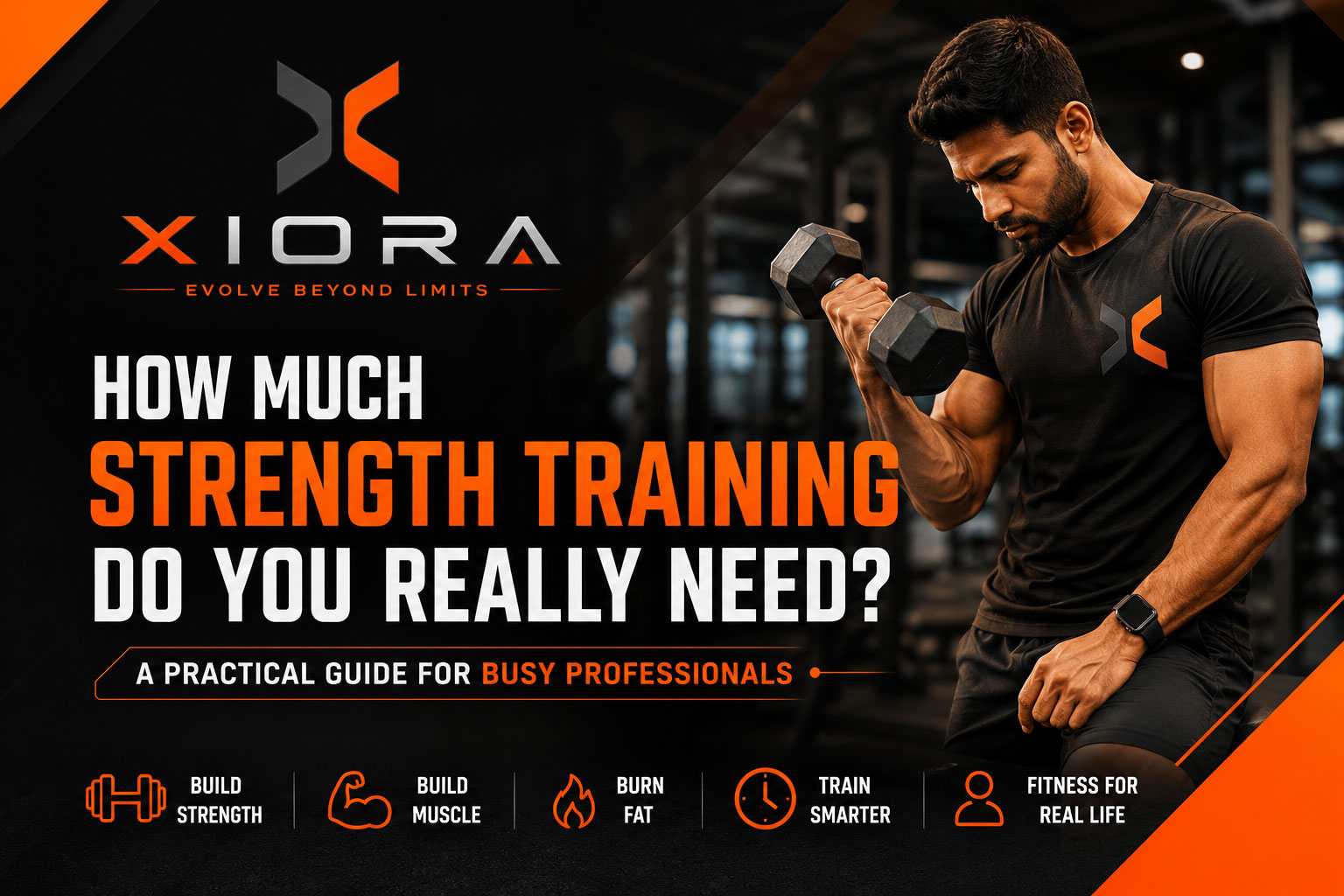
If you have a full-time job, a family, a long commute and a calendar that already feels packed, finding time for fitness can seem difficult.
You may have looked at fitness influencers training five or six days a week and thought:
“How am I supposed to fit all of that into my life?”
This is one of the reasons people often delay starting strength training. They assume that unless they can spend hours in the gym every week, their effort won’t be enough to make a difference.
But effective training isn’t about spending as much time as possible in the gym.
It’s about having a plan that matches your goals, your current fitness level, your available time and your ability to recover.
For one person, three focused sessions a week may be realistic. For another, two sessions may be the right place to begin. Someone with more training experience may be comfortable with four sessions.
The important question isn’t simply:
“How often should I train?”
It’s:
“What amount of training can I consistently do well and recover from?”
That is where structured strength training becomes different from simply exercising whenever you have time.
You Don’t Need to Live in the Gym
One of the biggest misconceptions about strength training is that more training automatically produces better results.
More exercises.
More sets.
More days.
More exhaustion.
But a difficult workout isn’t necessarily an effective workout.
Your body needs an appropriate training stimulus followed by enough recovery to adapt. If your programme consistently leaves you exhausted, interferes with your sleep or becomes impossible to maintain alongside your work and personal responsibilities, it may not be the right programme for you.
This is particularly relevant for working professionals.
Your training needs to fit into your actual life.
If you can realistically train three days every week, a well-planned three-day programme can be much more useful than an ambitious six-day programme that you follow for two weeks and abandon.
So, How Many Days Should You Strength Train?
There isn’t a universal number that applies to everyone.
For many beginners, two or three well-structured sessions per week can provide a practical starting point.
Someone with more experience may prefer three or four sessions depending on their goals, training capacity and recovery.
But frequency is only one part of the equation.
Your programme should also consider:
- Your current fitness level
- Training experience
- Fitness goals
- Available time
- Recovery capacity
- Mobility
- Lifestyle
- Previous training history
- Physical limitations
- Consistency
This is why personalised training matters.
A beginner learning the fundamentals shouldn’t necessarily train like someone who has been strength training for years.
Someone focused on muscle building may require a different programme from someone whose priority is fat loss.
And someone with limited time may need a more efficient programme rather than simply being told to train more often.
What Should a Strength Training Session Actually Achieve?
A good workout doesn’t have to leave you completely exhausted.
It needs to have a purpose.
Depending on the individual, strength training can help develop several areas.
Strength
Improving your ability to produce force and handle resistance with control.
Muscle Development
Providing an appropriate stimulus to build and maintain muscle.
Movement Quality
Developing better control and technique during different movements.
Mobility
Supporting the range of motion needed for training and everyday activities.
Stability
Improving your ability to control movement and maintain appropriate positions.
Physical Capacity
Helping you become more capable of handling everyday physical demands.
The objective isn’t to make every workout harder than the previous one.
The objective is to help your body gradually become stronger and more capable.
✍️ What If You Only Have Three Days to Train?
This is where having a structured programme becomes particularly useful.
If your schedule allows only three sessions a week, you don’t need to feel that you’re automatically falling behind.
A programme can be designed around major movement patterns and developed progressively over time.
For example, a programme could incorporate:
- Lower-body strength
- Upper-body pushing movements
- Upper-body pulling movements
- Core training
- Mobility work
- Full-body movements
- Conditioning where appropriate
The exact structure depends on the individual.
Your goals, training history, recovery and available time should determine the programme—not a generic template from social media.
The objective is to make the time you have productive.
✍️ What If Your Goal Is Fat Loss?
Fat loss is another area where people often assume that more exercise is always the answer.
You may see someone spending an hour on a treadmill and assume that is what you need to do to lose body fat.
But your overall body composition is influenced by much more than a single workout.
Training is one part of the picture.
Nutrition, daily movement, sleep, recovery and consistency also matter.
Strength training can play an important role when the goal is to improve body composition because the objective isn’t simply to make your body weight smaller.
You also want to maintain or develop muscle and improve your physical capacity.
This is where a fat loss and body recomposition approach can be more useful than simply chasing calories burned during exercise.
✍️ What If Your Goal Is Muscle Building?
Muscle building doesn’t require spending your entire week in the gym either.
What matters is providing an appropriate training stimulus and progressively challenging the body over time.
Progress can take several forms.
It might mean:
- Increasing resistance
- Performing additional repetitions
- Improving technique
- Controlling the movement better
- Increasing range of motion
- Managing training volume appropriately
Adding weight to the bar is not the only definition of progress.
Sometimes improving technique is progress.
Sometimes doing the same exercise with better control is progress.
And sometimes reducing training volume is the right decision because your body needs more recovery.
Good coaching involves knowing the difference.
✍️ What About Complete Beginners?
If you’ve never trained before, you don’t need to walk into a gym and immediately start lifting heavy weights.
Your first goal should be to learn.
Learn how the exercises work.
Learn how to control your movements.
Learn how to use equipment.
Learn how your body responds to resistance.
And, importantly, build confidence.
For a beginner, the first stage of training should establish a foundation that can be progressively developed.
This is particularly important for people who feel uncomfortable in gyms or have spent years believing that strength training is only for athletes or experienced lifters.
Strength training can be adapted to different levels of experience.
The starting point simply needs to be appropriate for the person.
✍️ Training Hard Without a Plan Can Become Counterproductive
Working hard isn’t the problem.
The problem is when effort replaces direction.
You can train every day, sweat heavily and still have no idea whether you are actually progressing.
A structured programme gives you measurable things to work towards.
You can ask:
- Am I becoming stronger?
- Is my exercise technique improving?
- Am I recovering properly?
- Has my mobility improved?
- Can I perform movements that were difficult previously?
- Are my body-composition goals progressing?
- Can I maintain this routine consistently?
These questions tell you much more about your progress than simply asking whether you were exhausted after the workout.
✍️ The Best Programme Is the One You Can Sustain
This is perhaps the most important principle.
If you can realistically train three days a week for the next year, that may be significantly more valuable than training six days a week for three weeks and then stopping.
Fitness is not built by one perfect week.
It is built through repeated effort over time.
One missed workout won’t destroy your progress.
One extremely hard workout won’t transform you overnight.
What you repeatedly do over months and years matters much more.
That is why good coaching should consider not only what you can do, but what you can continue doing.
✍️ Your Training Should Adapt as Your Life Changes
Your fitness programme doesn’t have to remain exactly the same forever.
Your work schedule may change.
Your goals may change.
Your training experience may change.
Your recovery may change.
Your priorities may change.
Your programme should be capable of changing with you.
A working professional may need a time-efficient programme.
Someone travelling frequently may benefit from online strength coaching.
Someone returning to training after a long break may need a gradual progression.
Someone working towards muscle development may require a different training structure.
There is no single perfect programme.
There is a programme that is appropriate for you at this stage of your journey.
✍️ PRACTICAL TIPS / CHECKLIST
Before Starting Strength Training, Ask Yourself:
1. What is my actual goal?
Do you want to build muscle?
Lose fat?
Become stronger?
Improve mobility?
Improve your overall fitness?
Your goal should influence how your programme is structured.
2. How much time can I realistically commit?
Don’t build your plan around an ideal week.
Build it around your real week.
If three days is realistic, start there.
3. Can I recover from the training?
Training is only one part of the process.
Sleep, nutrition and recovery matter too.
4. Am I progressing?
Keep track of meaningful improvements rather than simply counting workouts.
5. Is my programme appropriate for me?
Your training should reflect your experience, goals, lifestyle and individual requirements.
6. Can I sustain it?
A sustainable programme will almost always be more valuable than an extreme programme you cannot maintain.
✍️ LOCAL RELEVANCE — TRIVANDRUM
Strength Training in Trivandrum: Choosing an Approach That Fits Your Life
For someone looking for strength training in Trivandrum, the decision shouldn’t simply come down to finding the closest gym.
The more important question is whether the coaching approach matches what you actually need.
A beginner may need help learning basic movements and becoming comfortable with strength training.
A working professional may need an efficient programme that fits around a demanding schedule.
Someone focused on muscle building may need structured progression.
Someone working towards fat loss may need a combination of strength training, nutrition guidance and sustainable lifestyle changes.
And someone who cannot train consistently in person may benefit from online coaching.
With Get Fit With Kannan, the focus is on personalised strength coaching built around the individual’s goals, experience, lifestyle and training needs.
For clients who prefer in-person coaching, one-to-one personal training can provide direct guidance and exercise feedback.
For clients in other parts of India or outside the country, online strength coaching can provide a structured way to receive personalised training and accountability remotely.
The objective remains the same:
Create a training approach that works for the individual—not simply another generic workout programme.
✍️ FAQ
✔️ How many days a week should a beginner strength train?
Two to three structured strength-training sessions per week can be a practical starting point for many beginners. The appropriate frequency depends on the individual’s goals, fitness level, recovery and schedule.
✔️ Is three days of strength training enough to build muscle?
Three well-structured sessions can provide a strong foundation for muscle development. Results depend on the overall programme, progressive training, nutrition, recovery and consistency.
✔️ Can strength training help with fat loss?
Yes. Strength training can form an important part of a fat-loss and body-recomposition approach. Nutrition, daily activity, sleep and overall lifestyle also influence results.
✔️ Can busy professionals benefit from personal training?
Yes. Personal training can help structure workouts around limited availability, individual goals and lifestyle demands, making training more focused and easier to follow consistently.
✔️ Can I do strength training online?
Yes. Online strength coaching can be suitable for people who live outside Trivandrum, travel frequently or prefer training independently with professional guidance, provided the coaching system includes appropriate programming, feedback and progress tracking.
✔️ Do I need to lift heavy weights to become stronger?
Not necessarily. Strength development starts with appropriate resistance, good technique and progressive training. The amount of resistance should match the individual’s experience, ability and goals.
✍️ CONCLUSION
You don’t need to spend every day in the gym to become stronger.
You don’t need complicated workouts.
And you don’t need to finish every session feeling completely exhausted.
What you need is a structured approach that matches your goals, your lifestyle and your ability to recover.
For some people, that might mean two or three sessions a week.
For others, it may be more.
The important thing is to start with something realistic, learn the fundamentals, progress gradually and remain consistent.
Because the most impressive training programme isn’t necessarily the best one.
The best programme is the one you can follow consistently enough to create real change.
✍️ Contact Us
Ready to Start Strength Training?
Whether your goal is to build muscle, lose fat, improve mobility or become stronger, your training should be designed around your individual needs.
Explore personalised coaching with Get Fit With Kannan.
CTA: Book a Fitness Consultation
👉 Personalised strength training
👉 Fat loss and body recomposition
👉 One-to-one personal training